How to Organize a Company Fitness Challenge: 9-Step Guide
A company fitness challenge is one of the simplest ways to get employees moving, connect teams and build healthier habits. But many challenges lose steam after the first week – usually because of decisions made before day one. This guide walks you through how to organize a company fitness challenge step by step, so people join, stay and keep the habits afterwards.
Table of Contents
What Is a Company Fitness Challenge?
A company fitness challenge is a time-limited competition or shared goal in which employees track an activity – steps, distance, active minutes, workouts or healthy habits – individually or in teams. Most companies run them for a few weeks, using an app that collects data from employees' phones and smartwatches automatically.
How to Organize a Company Fitness Challenge in 9 Steps
1. 1. Set a Clear Goal
Decide what you want the challenge to achieve: more everyday movement, stronger connections between teams or offices, a healthier start to the season, or raising money for charity. Then decide how you will measure success – participation rate, how many people stay active until the end, and feedback afterwards.
2. 2. Choose the Right Challenge Type
The format shapes who takes part and how they behave:
- Total steps or distance: a classic leaderboard. Easy to understand and very motivating for competitive people.
- Activity-based: every sport counts, not just walking and running – fairer for cyclists, swimmers and gym-goers.
- Points-based: combine several activities and healthy habits in one score. See how YuMuuv's point system works.
- Consistency: instead of rewarding the biggest totals, count how many days each person reaches a daily goal.
Consistency challenges deserve a special mention. Classic leaderboards send an unspoken message that more is always better, which can lead to big swings in daily activity. A consistency challenge flips that around: the question is how many days in a period you meet your goal – for example, how many days you hit 10,000 steps, or whether you reach 100% of your activity index at least five days a week. As the saying often attributed to Craig Groeschel goes, successful people do consistently what others do occasionally – and the same is true for companies.
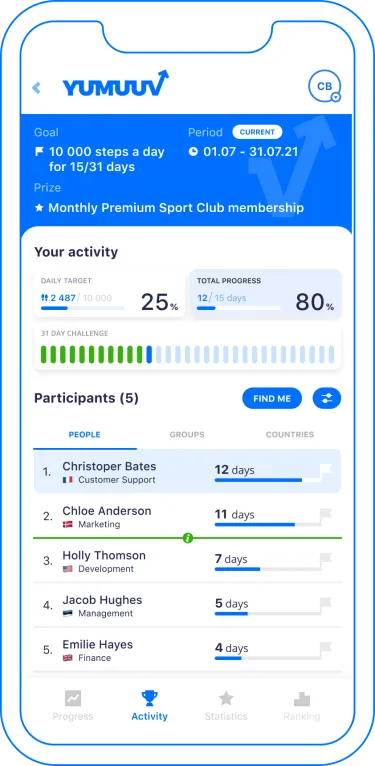
Browse the complete list of YuMuuv challenges or read about the differences between activity challenge types.
3. 3. Make It Inclusive
The people who benefit most from a challenge are often those who are least active today. Set goals that everyone can realistically reach, count different types of activity, and offer team formats where every contribution matters. Here is how to design challenges for non-competitive employees.
4. 4. Pick the Right Duration and Timing
Long enough to build a habit, short enough to stay exciting: many companies choose four to six weeks, while short two-week sprints work well before holidays. Avoid your busiest business periods and use the seasons to your advantage – our wellness challenge calendar has a theme for every month.
5. 5. Use a Platform That Tracks Activity Automatically
Spreadsheets and manual reporting kill participation. Choose an app that syncs with the devices people already use – Apple Health, Health Connect, Garmin and others – and updates leaderboards automatically. It also makes the challenge fairer: see how to create a culture where no one cheats.
6. 6. Form Teams Wisely
Team challenges create accountability and new connections. Mix departments and locations, keep teams similar in size, and let teams pick fun names – here are 80 walking team name ideas.
7. 7. Plan Rewards That Motivate Everyone
Prizes only for the top three motivate the top ten people. A prize draw among everyone who reaches a realistic goal keeps the whole company engaged until the end. Find more ideas in our guide to wellness challenge rewards.
8. 8. Launch With Energy
Announce the challenge at least a week in advance, explain how to join in a few simple steps, and ask leaders to take part visibly. Short on time? Here is how to launch a wellness challenge in 7 days.
9. 9. Keep the Momentum and Celebrate
Share weekly updates, highlight personal stories, and add small twists along the way such as mini competitions or Fitness Fridays. At the end, celebrate everyone who took part – and turn the challenge into a story people talk about.
Common Mistakes to Avoid
- Setting goals that only the fittest can reach.
- Making it hard to join or requiring manual data entry.
- Rewarding only the top performers.
- Launching and then going silent until the final results.
More pitfalls are covered in 10 common mistakes to avoid when planning a wellness challenge.
Frequently Asked Questions
1. How long should a company fitness challenge last?
Four to six weeks is a common choice: long enough to build habits, short enough to keep energy high. Short two-week challenges work well as a quick boost.
2. How do you make a fitness challenge fair for different fitness levels?
Use team formats, count many types of activity, and consider consistency or goal-based challenges where everyone who reaches a realistic target is a winner.
3. What are good prizes for a company fitness challenge?
Experiences, extra time off, wellness gear and charity donations all work well. Drawing prizes among everyone who reaches the goal motivates more people than rewarding only the winners.
4. Do employees need a smartwatch to take part?
No. Most phones count steps on their own, and apps like YuMuuv also connect to smartwatches and fitness trackers for more complete data.
Organize Your Company Fitness Challenge With YuMuuv
YuMuuv makes it easy to run step, activity, points and consistency challenges for teams of any size, with automatic tracking from the devices your employees already use. Book a demo and launch your first challenge in days, not weeks.